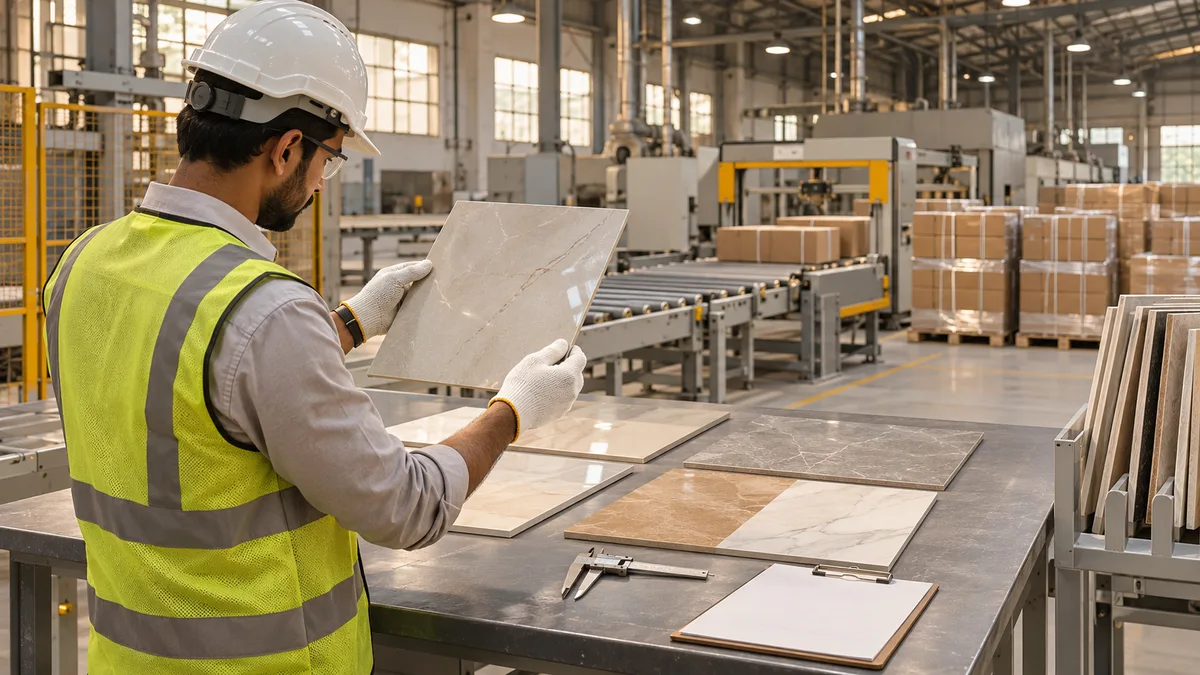
To find a genuine OEM Tile Manufacturer in India, connect the seller’s legal identity to the actual production site, the product being offered and the party responsible for your order. Verify those links independently where possible. A registration document, attractive catalogue or factory video can support the enquiry, but none proves the complete manufacturing relationship or the suitability of a particular tile on its own.
This guide is for buyers who already have a shortlist and need to decide whom to trust with a private label order. It does not rank factories or promise that every trader is unreliable. Instead, it provides a practical evidence trail: identify the seller, inspect the claimed manufacturing relationship, verify relevant product documents and record who must answer if the delivered goods differ from the agreement.
Map the seller and the actual manufacturing relationship
Ask the supplier to identify the contracting seller, manufacturing entity, production address and exporter for the proposed product. These may be different entities for legitimate reasons, but the relationship should be explained clearly. Put the names beside each other and ask which party issues the invoice, receives payment, manufactures the tile and accepts responsibility for quality or delivery questions under your contract.
Treat transparency as more useful than a preferred label. A direct manufacturer may use a separate export company, while a trading business may openly coordinate several producers. The risk appears when the claimed arrangement cannot be supported or changes without explanation. If your purchase depends on a particular plant or production capability, write that requirement into the order and request evidence tied to that specific site.
- Seller identity: Obtain the legal name and registered business address.
- Manufacturing identity: Request the plant name and address for the selected product.
- Commercial responsibility: Identify who handles production queries, claims and remedies.
- Export arrangement: Ask why the exporter’s name differs if another entity handles shipment.
Verify business records without mistaking them for factory proof
Use official records to check the identity a supplier has supplied, rather than relying only on screenshots. The DGFT IEC user manual describes the View Any IEC service for checking importer-exporter details. Follow the current official process and compare the result with the proposed seller or exporter. Keep a dated note of what was checked and any mismatch requiring explanation.
Understand what each check leaves unanswered. An exporter record does not show which factory will make your tile or whether that tile meets a project requirement. Likewise, an invoice name matching a registration does not establish ownership of a manufacturing line. Use business records as one layer in the evidence trail, then separately verify site access, product records and the relationship between the proposed seller and producer.
| Evidence | What it helps establish | What it does not prove alone |
|---|---|---|
| Official business or exporter record | Identity associated with the registration | Ownership of the production plant |
| Site visit or live walkthrough | Access to the claimed operating location | Compliance of every delivered product |
| Product-linked test documentation | Results for the identified sample and method | Quality of an unrelated batch |
| Approved reference sample | The agreed appearance and product reference | Consistency of future production |
| Written order and responsibility map | Which party accepted the commercial obligations | That every obligation will be performed |
Start with an identifiable product enquiry
Choose the relevant ORKAY Tiles product category before asking for factory and technical evidence. Its B2B solutions page describes the private label offer, which helps you identify the proposed commercial arrangement. Send the desk a product-specific brief and ask for supporting information connected to that order. A precise enquiry makes the answers more useful than a generic request for company credentials.
Use factory access to test the supplier’s explanation
Request a site visit or live walkthrough that follows the selected product through relevant stages. Ask to see where it is inspected, identified and packed, and request an explanation of how the product reference connects with the order documents. Use follow-up questions during the visit. An edited promotional video may show a factory, but it does not establish the presenter’s authority over your proposed production.
If a visit is impractical, ask an independent inspection provider what it can verify at the named site. Set the scope before paying: identity, access, process observations or product inspection are different tasks. A limited report should not be treated as an unlimited endorsement. Where the supplier will not explain the plant relationship or permit a reasonable verification route, keep that uncertainty visible in the buying decision.
- Trace a reference: Ask how the selected model appears in production and packing records.
- Test the relationship: Ask who authorises production and who can resolve a product query.
- Confirm inspection access: Agree when your appointed inspector can attend and what can be checked.
- Record limitations: Note areas or documents that were unavailable instead of assuming they passed.
Match quality evidence to the product you will buy
Read technical evidence for identity and relevance before treating it as reassurance. Check the issuing organisation, sample description, product reference, test method, result and date. Ask how the tested sample relates to the offered tile and intended application. If a document cannot be connected to the proposed product, request an explanation or additional evidence instead of assuming the result applies across the supplier’s catalogue.
Where a BIS mark is claimed, the Bureau of Indian Standards describes its Verify Licence Details feature for checking authenticity. Use the official facility for the relevant claim and review the details returned. Do not treat one mark or management certificate as a substitute for all destination requirements. Ask a qualified adviser which product evidence is needed for your market and application.
Ask questions tied to the intended application
Share whether the tile is intended for a wall, a commercial floor or another specific use when contacting the ORKAY Tiles enquiry desk. Use the catalogues to identify the proposed reference, then ask which technical documents support that selection. Product-specific questions help distinguish relevant evidence from a general company brochure and give your project team something concrete to review before approval.
Link sample approval, payment and dispatch records
Make the approved sample traceable to the commercial order. Retain the sample reference, agreed specification, carton proof and any acceptance notes, then check that the purchase confirmation uses matching references. Ask how the supplier records batch identity and communicates approved changes. This helps prevent a good sample from becoming an isolated object with no reliable connection to the material that eventually reaches your warehouse.
Before payment, reconcile the beneficiary details with the agreed seller and explain any difference through an independently verified contact. Treat an unexpected change as a reason to pause and confirm, rather than following an email instruction alone. Payment terms and inspection milestones should fit the parties’ agreement. No payment structure removes every risk, so retain the complete record and clarify the remedy process before authorising dispatch.
- Order match: Compare the product reference across quotation, approval and confirmation.
- Payment match: Confirm the beneficiary and any authorised third-party arrangement.
- Dispatch match: Check packing and shipment records against the approved order.
- Claims route: Keep the responsible contact, evidence requirements and agreed response process together.
Decide using an evidence trail you can explain
Choose a supplier whose identity, manufacturing arrangement and product evidence form a coherent chain. Do not reduce the decision to a certificate count or a confident factory claim. Record what each check establishes, what remains uncertain and whether that uncertainty matters for the order. A small unresolved naming difference may be explainable; an unexplained producer or unrelated product document can affect the foundation of the purchase.
Move from shortlist to commitment in stages: clarify the parties, verify the site relationship, approve the specification and agree the commercial record. Recheck any material change before payment or dispatch. Keep the resulting file for future orders and update it when the product, producer or contracting entity changes. The objective is accountable supply backed by identifiable evidence, rather than a claim of certainty no verification process can provide.
Put the verification questions into your buying brief
Send the selected product, destination and verification requirements through the ORKAY Tiles contact page. Ask the desk to identify the proposed product references, manufacturing arrangement and supporting documents for your enquiry. Review the private label information alongside that response so the commercial offer and the evidence request describe the same programme before you decide whether to proceed with an order.
Questions
Frequently Asked Questions
Does an IEC prove that a supplier manufactures tiles?
No. Checking an importer-exporter record helps verify the identity and details associated with that registration, but it does not establish ownership of a tile factory. Ask separately for the production entity, plant address and relationship with the seller. Combine official record checks with site verification and product-specific evidence so each part of the proposed arrangement has an appropriate supporting record.
Is buying through a trading company always a mistake?
No. A trading company may provide useful sourcing, coordination or export services when its role is transparent. Ask which producer will make the product and which party is responsible under your contract. Compare the arrangement with your need for direct factory access, repeat-order control and claims handling. The relevant issue is whether the service and accountability match the purchase, rather than the label alone.
What should I ask during a live factory walkthrough?
Ask how the selected product is identified, inspected and packed, and how those records connect to the quotation. Request explanations while the walkthrough is live rather than relying only on a prepared presentation. Also confirm who has authority over the proposed production. Record any areas or documents not shown so the walkthrough’s limits remain clear when you assess the evidence later.
Can a test report cover every tile in a catalogue?
Do not assume it does. Check the sample description, product reference, test method and result, then ask the supplier to explain the report’s relevance to your selected tile. Different products or intended uses may need different evidence. If the link is unclear, request clarification or appropriate testing before relying on the document for project acceptance or destination-market requirements.
What if the bank beneficiary differs from the seller?
Pause payment until the arrangement is explained and confirmed through a contact route you have independently verified. A group company or authorised commercial arrangement may have a legitimate explanation, but the difference should be documented. Check that the contract, invoice and payment instructions are consistent with that explanation. Do not treat a last-minute email about changed bank details as sufficient verification on its own.
Should I appoint an independent inspector before the first order?
Consider it when the order’s value, product complexity or limited factory access makes independent verification useful. Define the scope carefully: checking site identity, observing production and inspecting finished goods answer different questions. Ask what the report will include and exclude, and agree access with the supplier. Inspection can improve the evidence available to you, but it does not replace a clear specification or contract.
How do I verify ORKAY Tiles for my proposed OEM order?
Start with the specific product and private label requirements, then ask the ORKAY Tiles desk for the relevant commercial and technical information. Compare the identified parties, product references, approvals and supporting records using the same method applied to other suppliers. Its published product and solutions pages help frame the enquiry, while order-specific details should be confirmed directly before making a purchasing commitment.