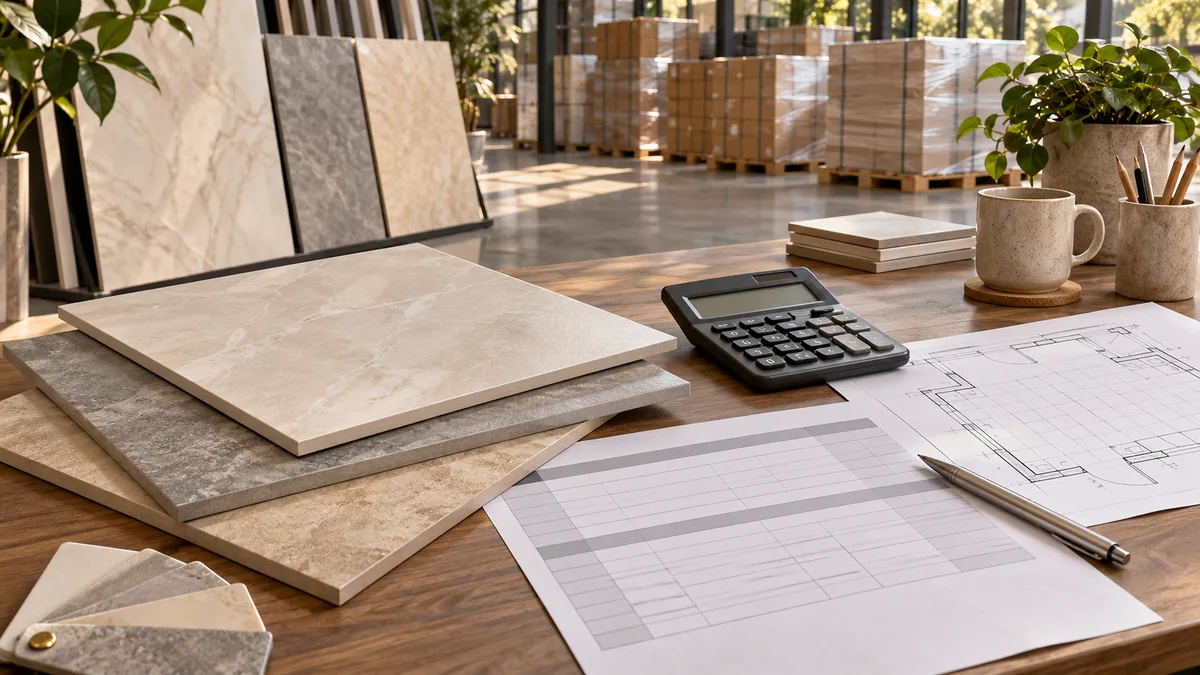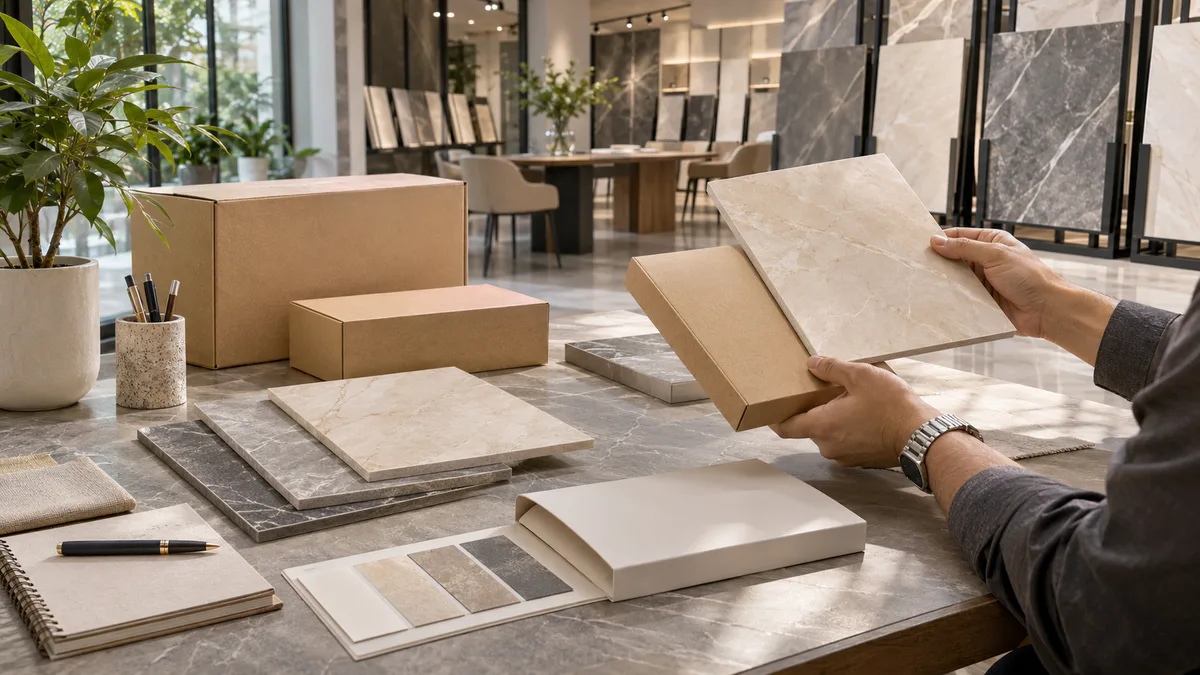
An OEM Tile Manufacturer in India should be evaluated against the private label programme you actually need: the product, the carton, the approvals and the repeat-order process. Start by defining what will change from an existing range and what must remain exclusive to your brand. A supplier’s use of the word OEM does not, by itself, settle those commercial and technical details.
This guide focuses on building the programme after you have decided to explore your own tile label. It is written for importers, distributors and retail brands preparing their first purchasing brief. Factory verification remains a separate step. Here, the priority is turning a broad branding idea into a product and approval package that the buyer and manufacturer can both use when placing and repeating orders.
Define what your private label programme includes
Separate a branded existing product from a product-development request. You may need an available tile in your own carton, a coordinated range selected for your market, or a more specific design and technical brief. Write down which arrangement you want before discussing price. Otherwise, suppliers can answer different questions while appearing to quote the same private label opportunity for your business.
Define the commercial boundary just as carefully. A branded carton does not establish ownership of the design or promise that another buyer cannot purchase a similar tile. Discuss exclusivity only where it matters and request its scope in writing. Identify the product, territory, sales channel, duration and conditions involved, then obtain suitable professional advice before relying on an agreement for protection of your brand investment.
- Branding only: Identify the carton, sleeve, label and catalogue changes required.
- Range selection: Define the product mix and applications your customers need.
- Product development: List requested changes and the evidence needed to approve them.
- Exclusivity: State exactly what you want restricted, where and under which conditions.
Build the tile specification before approving artwork
Build the product specification around use rather than appearance alone. Record the body, dimensions, thickness, finish, edge, grade and intended application. Add the required technical evidence for that application and destination. A surface that photographs well still needs to meet the buyer’s project requirements. Ask the supplier to identify which existing product matches the brief and which details need further confirmation.
Keep the commercial catalogue and the acceptance specification connected but distinct. A catalogue helps customers choose a look; an acceptance record tells the buyer what was ordered. Link the brand’s product code to the manufacturer’s reference and approved sample. If either side changes a reference later, require an updated record so the warehouse, sales team and next purchase order continue to identify the same product.
| Approval record | What it identifies | Why it belongs in the programme |
|---|---|---|
| Product specification | Body, format, finish and intended use | Makes supplier offers comparable |
| Sample approval | Reference sample and acceptance notes | Anchors appearance discussions |
| Packaging proof | Approved carton and label version | Prevents old or incorrect artwork |
| Order confirmation | Quantity, product code and delivery terms | Connects approvals to the actual purchase |
| Change record | Agreed revisions and effective order | Protects repeat-order consistency |
Build a range your sales team can explain
Use ORKAY Tiles collections to identify relevant categories before requesting a private label discussion. Its B2B solutions page describes support for branded cartons and product selection, giving you a practical starting point for the brief. Share your market and customer applications with the desk, then ask which product references can support that range without assuming every custom request is available.
Approve packaging as a controlled product document
Approve the carton as a working product document, rather than an attractive graphic alone. Confirm the brand name, product reference, unit information, handling instructions and batch-identification approach. Check the destination’s applicable labelling requirements with a qualified local adviser. Do not copy a competitor’s carton and assume that its wording, symbols or technical claims apply to the tile you intend to import and sell.
Use a versioned proof that both parties retain. The supplier should know which file is approved, while your team should understand whether a later edit affects print stock, dispatch or product identification. ORKAY Tiles states on its private label page that artwork, carton design and shade approval are settled before a run starts. Ask for the corresponding approval steps for your proposed order.
- Content review: Check product naming, units and all destination-specific information.
- Print review: Confirm colour expectations, layout and the final approved file.
- Traceability review: Keep a route from the branded carton to the agreed product and batch.
- Change review: Decide who can authorise revised artwork and which order uses it.
Agree quality acceptance and repeat-order controls early
Agree how quality will be judged before the goods are produced. Identify the reference samples, technical documents, inspection arrangements and records needed for acceptance. Ask how shade, dimensions and packing information will be communicated for the selected range. A general assurance of good quality does not explain what happens if a delivery differs from the approval or which evidence supports a claim.
Plan repeat orders around identifiable records rather than a photograph from the launch. Retain approved references, previous purchase details and any accepted variations. Ask whether a proposed repeat order needs a fresh sample or batch review, especially where new material will sit beside an earlier delivery. Treat a claim of exact repeatability as something to define and verify, rather than a promise implied by the OEM label.
Keep the approval trail easy to follow
Prepare a shared approval list covering product reference, sample, carton and shipment requirements. Discuss that list with the ORKAY Tiles B2B desk alongside the published private label offer. Ask which documents will accompany your order and who handles technical questions. A clear approval trail helps both teams identify the affected item when a product detail or packaging file changes.
Compare setup costs and delivery responsibilities honestly
Compare the complete programme rather than a tile price stripped of its conditions. Ask whether samples, artwork changes, special packing, inspection or other requested work carry separate charges. Request product-specific order quantities and timing directly from the supplier. There is no universal ORKAY MOQ or lead time in this guide, and a requirement quoted by another business does not establish the terms for your programme.
For international orders, connect the quotation to a named delivery point and agreed responsibilities. The International Chamber of Commerce explains that Incoterms rules address delivery tasks, costs and risks. Use that framework with written inclusions and exclusions, then confirm destination requirements through your own advisers. A branded carton does not remove the need to understand clearance, local handling and product compliance.
- Setup costs: Ask which requested changes are included and which are charged separately.
- Stock exposure: Check whether the proposed range creates quantities your market can absorb.
- Delivery planning: Confirm the selected product’s packing and proposed shipment arrangements.
- Claims handling: Record contacts, evidence requirements and the agreed remedy process.
Launch with a repeatable brief rather than assumptions
A workable private label programme connects the product customers see with the manufacturing and approval records behind it. Choose the supplier whose offer clearly matches your specification, branding requirements and acceptance process. Avoid treating a catalogue selection as a complete production brief. The first order should leave your business with records it can use for technical answers, customer questions and future purchasing decisions.
Start with a focused range, prepare a written approval package and confirm its commercial terms before committing. After arrival, compare the delivered goods and cartons with that package and record any agreed corrections. Use the findings to improve the next order instead of rebuilding the conversation from memory. That discipline gives your brand a clearer operating base as its assortment, customers and repeat-order needs develop.
Turn your brand idea into an order brief
Send your target market, intended applications, preferred tile references and packaging requirements through the ORKAY Tiles contact page. Review the catalogues first if the range is still open. Ask the team to confirm product suitability, approval steps and current commercial terms against your brief, so your next decision rests on a concrete proposal for your own brand.
Questions
Frequently Asked Questions
Does OEM automatically mean a completely exclusive tile design?
No. The term alone does not define design ownership or exclusivity. Ask whether the offer uses an existing design, a modified product or development against your own brief. If exclusivity matters, request its product, territory, channel and duration in writing. Have the agreement reviewed appropriately before building marketing claims or a distribution plan around an assumption that no other buyer can obtain similar material.
Can I begin with an existing tile range in my own carton?
That may be a suitable programme if the manufacturer offers the arrangement for your chosen products. ORKAY Tiles describes private label cartons on its solutions page, but the specific range, quantities and timing still need confirmation. Define the artwork, product references and destination requirements together so the supplier can explain which parts of your request fit its current offer.
Who should check the wording printed on the packaging?
Your brand should appoint someone to approve the commercial wording and obtain local advice on applicable product labelling. The manufacturer should confirm the product information it supplies and the final print file it will use. Record both approvals. A supplier’s willingness to print a symbol or claim does not establish that your brand is entitled to use it in the destination market.
What should I retain after approving a tile sample?
Keep an identified reference sample, its product code, approval date and written acceptance notes. Connect those records to the manufacturer’s reference and your brand’s own product name. Store the associated technical documents and carton version as well. The objective is a usable link between the sample, the purchase order and the delivered batch, rather than a loose sample with an uncertain history.
Should every repeat order use the original artwork file?
Only if that file remains the approved version and its product information is still correct. A new product reference, packing change or revised market requirement may need an update. Keep a version record and tell the supplier which order introduces the change. Also ask how any already printed packaging will be handled so old and new versions do not circulate without explanation.
How can I compare two private label manufacturing proposals?
Use the same product brief and delivery basis, then compare approvals, setup work, packing, inspection, documentation and repeat-order controls. Keep exclusions and unconfirmed items visible. A lower tile price may cover a narrower service scope, while a larger offer may contain work you do not need. Choose the proposal that meets the actual programme rather than the one with the broadest marketing description.
What information does ORKAY Tiles need for a private label enquiry?
Provide your destination market, customer applications, selected references, expected quantities and the branding changes you want. Include any required technical evidence and packaging approval process. ORKAY Tiles publishes product categories, catalogues and a private label offer to help start that discussion. Request current product-specific terms directly, because a general guide cannot establish the price, order quantity or production timing for your brand.