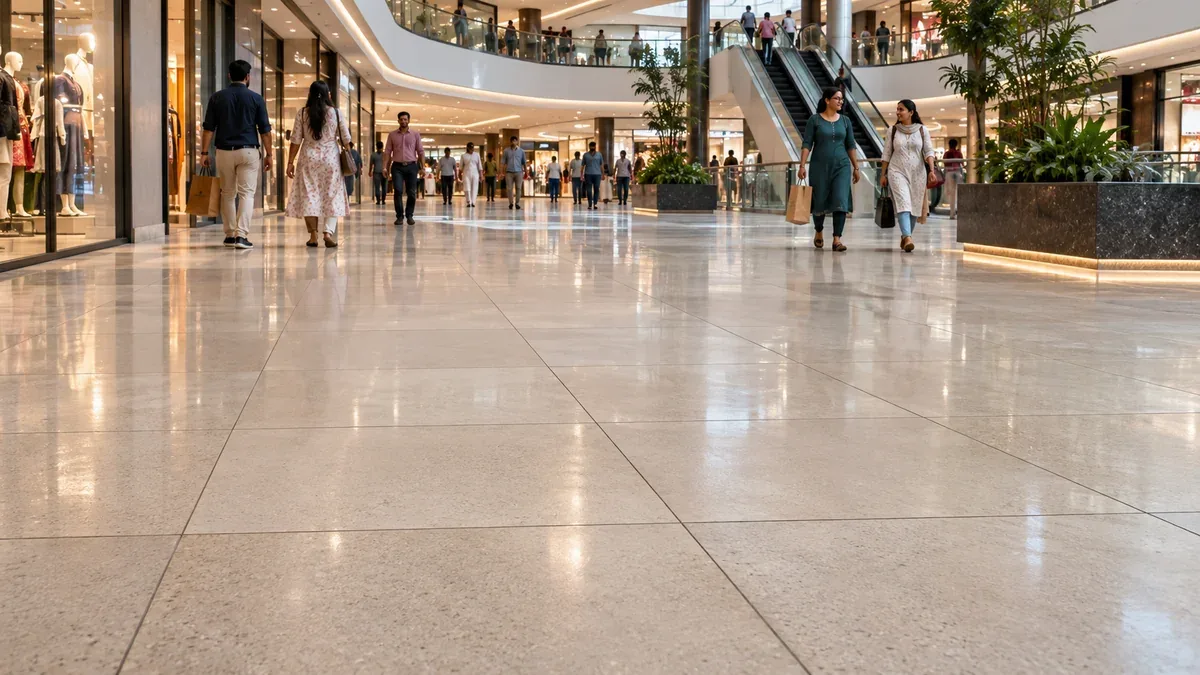
A practical shortlist of double-charge vitrified tile manufacturers to investigate includes Kajaria, Somany, Orientbell, Simpolo and Asian Granito. Each publishes a relevant range or catalogue reference. This is an enquiry shortlist, not an independently measured top-five ranking or a finding that every listed product suits every high-traffic mall. The selected product still needs assessment against the actual project specification.
Mall flooring must be evaluated by zone, including entrances, circulation areas, food-related spaces and service routes with different exposure and traffic. Manufacturing category alone does not prove slip performance, appearance retention or installation suitability. Ask all shortlisted suppliers for the same product-specific submission before comparing commercial offers or allowing a familiar brand name to decide the specification.
Use primary product information to build the shortlist
Kajaria publishes a double-charge category, while Somany's Ultra Charge page identifies its double-charge offering. These sources establish relevant ranges for an enquiry. They do not constitute independent comparison of mall-floor performance, establish current stock for your location or prove that every size and finish is approved for the same application.
Orientbell's category page, Simpolo's collection listing and Asian Granito's double-charge catalogue provide further supplier-published starting points. Request current product identification and technical files directly because catalogue availability and exact ranges can change. Inclusion here concerns a published offering, not endorsement of unrelated claims or a guarantee of suitability for your mall.
- Treat the five names as candidates for a comparable enquiry.
- Request the current product file for the exact proposed finish.
- Keep manufacturer statements separate from independently checked project evidence.
Compare five candidates against the same requirement
Define the dimensions, finish, intended zones and required evidence in one enquiry document. Ask each supplier to identify a specific product rather than respond with its entire corporate catalogue. That makes comparison useful because commercial and technical teams can assess equivalent proposals instead of comparing a polished range from one company with a different construction or finish from another.
Record missing information without automatically interpreting it as product failure or acceptance. A manufacturer may need to clarify a report's scope or propose another product for a particular zone. Keep the decision trail clear so the final selection reflects evidence and project requirements rather than a numeric ranking invented from website prominence, company size or general marketing language.
| Candidate | Primary range reference | Project check still required |
|---|---|---|
| Kajaria | Published double-charge category | Exact product and zone suitability |
| Somany | Ultra Charge collection | Applicable finish and technical submission |
| Orientbell | Double-charge category | Current product evidence and supply |
| Simpolo | Double Charge collection listing | Confirmed variant and relevant reports |
| Asian Granito | Double Charge catalogue | Current range and project acceptance |
Prepare a comparable mall-floor enquiry
Share the mall's zone schedule, product requirements and evidence checklist through Orkay's contact page if you also want an Orkay proposal for comparison. Ask the team to identify any suitable available range and its supporting information. Do not assume that this shortlist establishes Orkay's participation in a specific double-charge category or approves a product without review.
Review wear, loading and slip evidence by zone
Ask the project's technical designer to identify the relevant performance requirements and test methods for the proposed surface construction. Check that submitted evidence belongs to the actual product and finish. Terms such as heavy duty, scratch resistant or high traffic need a clear basis, especially where the purchasing brief includes wheeled equipment, concentrated loads or repeated cleaning operations.
Evaluate wet or contaminated conditions separately from a dry retail circulation area and do not treat a polished appearance as a slip-safety assessment. The designer should review the full application, including entrances and transitions between surfaces. Product comparisons are more useful when they state where evidence applies and where further review is needed than when they promise universal performance from the double-charge label.
- Separate pedestrian use from relevant wheeled and concentrated loads.
- Ask for the method and product identification behind each technical claim.
- Assess wet entrances and other contaminated zones independently.
Approve appearance and installation before bulk release
Review representative material under the project's lighting and agree the acceptable visual reference, joint layout and installation approach. A small showroom piece may not represent the appearance of a large circulation floor. Include the designer and contractor in the approval because the finished impression depends on tile variation, layout, lighting and workmanship as well as the chosen range.
Have the qualified installation team assess substrate requirements, movement accommodation and the appropriate assembly for the project. A product report does not correct an unsuitable substrate or replace the design of transitions and other details. Record the approved mockup and installation responsibilities before purchasing so a disagreement at handover can be traced to an understood acceptance basis.
Connect selection with the installed result
Use Orkay's business-solutions information to begin a project discussion, then provide the actual application and approval requirements. Request an identified product response and available supporting files rather than a generic statement about commercial flooring. Keep the final selection subject to the mall team's technical and mockup review, with design and installation responsibilities agreed separately.
Check project supply and replacement continuity
Ask each candidate to confirm the required quantity, proposed production or stock source and realistic dispatch sequence. A large product portfolio does not itself reserve material for the project. Agree how the supplier will identify production, notify changes and handle any additional quantity requested after the initial floor has been installed or partially released to tenants.
Compare quotations on the same supply scope and include any specifically agreed sampling, packing or delivery charges. Clarify whether additional matching material is included, reserved separately or subject to future availability. A lower initial price should be evaluated alongside the practical cost of replacement, delayed areas and maintaining an approved appearance across phased handovers without assuming identical future batches.
- Confirm quantity allocation and the proposed release sequence.
- Record change-notification and additional-order procedures.
- Compare equivalent commercial scopes after technical review.
Choose a product that passes the project review
The five published ranges create a useful starting point, but the best choice for a mall is an identified product that satisfies the project's technical, visual and commercial requirements. No evidence presented here supports a universal first-to-fifth performance ranking. A transparent shortlist is more useful when it tells the buyer what remains to be checked before award.
Retain the approved product files, mockup record, order specification and supply commitments together. Reassess proposed substitutions rather than allowing the selected brand name to stand in for the approved material. This approach turns a broad manufacturer search into a reviewable purchasing decision and gives the contractor, facility operator and procurement team a common basis for acceptance.
Request a documented project proposal
Contact Orkay with the mall application, desired appearance, quantities and technical checklist if you want to assess an additional supply proposal. Ask for clear product identification and current supporting evidence. Compare the response on the same basis as the shortlisted manufacturers and obtain project approval before treating any material as accepted for the intended high-traffic floor.
Questions
Frequently Asked Questions
Are these companies ranked from best to worst?
No. The five names form an enquiry shortlist based on supplier-published double-charge ranges or catalogue references. The article does not present independent comparative testing or establish that one company universally performs better. Select the actual product through the mall's technical review, representative appearance approval and confirmed commercial and supply requirements for the intended zones.
Which five manufacturers can buyers investigate?
Kajaria, Somany, Orientbell, Simpolo and Asian Granito publish relevant double-charge references and can be investigated for an identified project enquiry. Check current products and supporting files directly because catalogue ranges can change. Inclusion does not certify every finish, establish stock or prove that any particular listed product meets all the requirements of your mall floor.
Does double-charge construction guarantee mall suitability?
No construction label should replace product-specific assessment. The project team must review the intended zone, surface finish, loads, contamination conditions and relevant evidence. Ask for a clearly identified technical submission and approved installation approach. A product suitable for one dry circulation area may need different review for entrances, service routes or areas with food and cleaning exposure.
Should a mall compare polished and matt finishes directly?
Compare them only against clearly stated appearance and performance requirements for the relevant zone. A different finish can change the evidence needed and the maintenance discussion. Ask the technical designer to review actual conditions and representative material, and avoid assuming that either a polished or matt label by itself establishes suitability or slip performance.
Why is a mockup useful for bulk flooring?
A representative mockup allows the project team to review appearance, layout, joints and workmanship together under relevant lighting. Record the approved material and acceptance basis before the full order is released. The mockup supports visual and installation decisions but should not be treated as a substitute for technical reports or the designer's complete flooring-system assessment.
How should replacement material be handled?
Agree whether additional material is purchased, separately reserved or subject to a later availability check. Record the product and production identifiers and the process for approving future material. Do not assume that a catalogue product name guarantees identical future appearance or unlimited availability, especially when the mall is handed over in phases or additional quantities are requested later.
Can Orkay provide another proposal for the project?
Submit the mall's product and technical requirements to Orkay and ask for an identified range with available supporting information. This article does not verify a specific Orkay double-charge product or its project suitability. Evaluate any response against the same evidence, mockup and commercial checks used for the shortlist before approving material for the intended floor.