The best Indian tile exporters are not the ones with the largest catalogue or the lowest quoted FOB price. They are the ones that can reproduce an approved shade in a second container six months later, and that still hold a shipment date when fuel, freight and container availability move against them. In 2026 those two capabilities stopped being a nice-to-have. Between April and June 2026, ceramic exports out of Morbi fell from about $616.78 million in the same quarter a year earlier to $184.19 million — a drop of roughly 70% — as gas costs, freight rates and container shortages hit at once, according to Vibes of India (published 10 August 2026).
That matters to you as a buyer because supplier selection criteria written for a calm market no longer separate the strong from the weak. A factory can show you a beautiful sample board, quote competitively and still be one of the units that suspended production for 30 to 45 days during the fuel squeeze. This guide explains what to inspect instead: how shade and calibre control actually works inside a plant, which capacity and fuel questions predict on-time dispatch, how to compare quotations on landed cost rather than per-square-metre price, and the documents that let you verify claims yourself before a deposit leaves your account.
What Actually Separates a Dependable Tile Exporter From a Trading Desk
The single most useful distinction in Indian tile sourcing is whether the company you are talking to fired the tile. A manufacturer-exporter owns the press, the glaze line, the kiln and the polishing line, so it can hold a batch, re-run a shade and tell you the real production status. A trading desk buys from whichever unit has stock at the right price that week, which is efficient for one-off loads and unreliable for a repeat range you intend to build a market around.
This shows up in a specific, expensive way: the reorder. If your first container of a marble-look vitrified tile sells well and the second container arrives half a tone lighter, the material is not defective, but it is unsellable alongside the first. A manufacturer can tie your reorder to recorded body, glaze and firing parameters and to a retained reference tile. A trader can only source something similar. ORKAY Tiles, a Morbi manufacturer and exporter operating since 1996 and shipping to 40+ countries, frames this as the job its manufacturing and quality desk is answerable for — in the words of director Vipul Patel, that "the shade you approved is the shade in the second container, and in the tenth."
- Ownership of the kiln: Ask which production units are owned versus contracted, and ask for the unit that will run your order by name. A supplier that cannot say where your tile will be fired cannot promise repeatability on it.
- Who answers when something is wrong: A named person with access to the production plan can hold a batch. A shared sales inbox can only forward your complaint to whoever sold the material.
- Catalogue depth versus running ranges: A large catalogue is only useful if the ranges you pick are in regular production. Ask which of your shortlisted designs ran in the last 90 days.
- Export documentation handled in-house: Packing lists, commercial invoices and container planning done by the factory's own export desk remove a layer of delay and of translation error.
How the 2026 Fuel and Freight Shock Changed Supplier Risk in Morbi
Gas is the cost that decides whether a Morbi kiln runs. The Vibes of India report puts gas at close to 40% of tile production cost, with piped natural gas moving from an average of about ₹48 per SCM before the crisis to a spot peak near ₹90 and stabilising around ₹79, and propane around ₹85. A separate market report carried by TradingView, citing Moody's, noted Kajaria Ceramics reporting tile price increases of 18–19% in Morbi, with a large share of the cluster's units non-operational during the worst of it.
Freight compounded it. The same Vibes of India report describes container rates to the UAE rising from roughly $300–400 to as much as $2,500, a 200–300% increase, alongside container shortages. National data tells the same story from the other end: Ceramic Post's HS 6907 series shows India's tile exports at ₹18,730 crore on 553.8 million sq m in FY26, then April–July FY27 at ₹4,199 crore — value down 33.8% and volume down 46.4% year on year, while realisation rose 23.4% to ₹419 per sq m. Less tile moving at a higher price per metre is exactly what a cost-push squeeze looks like, and it means a 2024-vintage quotation tells you nothing about 2026 deliverability.
For a buyer, the practical consequence is that fuel and capacity questions now belong in your supplier evaluation, next to the technical ones:
- Fuel mix and switchability: Ask whether the units can run on both piped natural gas and propane. A plant that can switch fuel keeps firing through a supply interruption; a single-fuel plant stops.
- Number of active lines: One line means one point of failure. Several lines on one campus let a planner move your order rather than push your date.
- Who books the container: Clarify whether the factory's export desk arranges equipment and bookings or whether that is left entirely to your forwarder, and agree who absorbs a rate change between order and dispatch.
- Price validity in writing: In a volatile fuel market, insist that the quotation states how long the price holds. Vague validity is where disputes start.
Get a straight answer on capacity before you commit stock money. Tell the ORKAY export desk the market, the sizes and the volume you need, and ask what is running now. The source for every answer is the plant itself — seven manufacturing units on one Morbi campus, a combined 60,000 sq m a day across four active lines, and a loading yard on site with Mundra port about three hours away. Send your requirement to the export desk and you will hear back within one business day.
How to Verify Shade Consistency and Calibre Before a Bulk Order
Shade consistency is controlled before firing, not inspected after it. By the time a tile leaves the kiln, the body recipe, the glaze application and the firing curve have already decided its tone, its calibre (dimensional size band) and its flatness. So the question to ask a supplier is not "do you check the tiles" but "what do you fix and record so that the check passes the second time." A factory that cannot describe its parameters and its retained references is relying on sorting, and sorting only removes outliers — it cannot recreate a tone.
Your own verification runs on three artefacts. First, a signed physical sample with a product code and a shade or batch marking, retained by both sides. Second, a technical data sheet quoting the test standards the tile is classified against — ISO 13006 and BS EN 14411 define porcelain as a body with water absorption below 0.5%, as summarised in the reference description of porcelain tile standards, with surface abrasion for glazed tiles tested under ISO 10545-7. Third, a pre-shipment report or loading photographs showing the shade and calibre markings printed on the cartons that were actually loaded. Without the third artefact, the first two are promises.
What a Shade and Calibre Marking on the Carton Tells You
Carton markings normally carry a shade code and a calibre code alongside the design name and size. Two cartons of the same design with different codes may lay fine in separate rooms but will show a visible line where they meet on one floor. Ask for one shade and one calibre across a single project quantity, confirm it on the packing list, and have your inspector photograph the end labels before the doors close — not after the container lands.
How Multiple Quality Gates Reduce the Risk You Carry
Staged inspection matters because each gate catches a different failure. ORKAY Tiles describes five gates between raw material and released shipment: pre-production control, in-process inspection, pre-packing checks, packing and pallet verification, and pre-shipment release. The practical value to you is that packing and pallet verification sits before pre-shipment release, so mixed shades and weak palletisation are caught while the material is still inside the gate rather than inside your container.
How to Judge a Factory's Large-Format Capability Honestly
Large slabs are where equipment gaps show. Flatness, edge straightness and vein continuity across a 800×2400 or 800×3000 mm slab depend on the press line, not on finishing. ORKAY runs its slab line on SACMI's CONTINUA+ system — described in the company's own plant information as one of only 60–70 units in use worldwide — pressing those two formats. If you are buying slabs, ask which press line runs them and ask to see a full-size sample rather than a cut piece.
Which Factory Capabilities Actually Protect Your Shipment Date
A shipment date is a scheduling output, not a sales promise. It holds when the supplier has spare line capacity, a fuel supply that does not stop, a loading facility that does not depend on a third-party yard, and a port close enough that drayage delays do not eat the cut-off. Remove any one of those and the date becomes an estimate the supplier will have to renegotiate with you — usually after you have already promised it to your own customer.
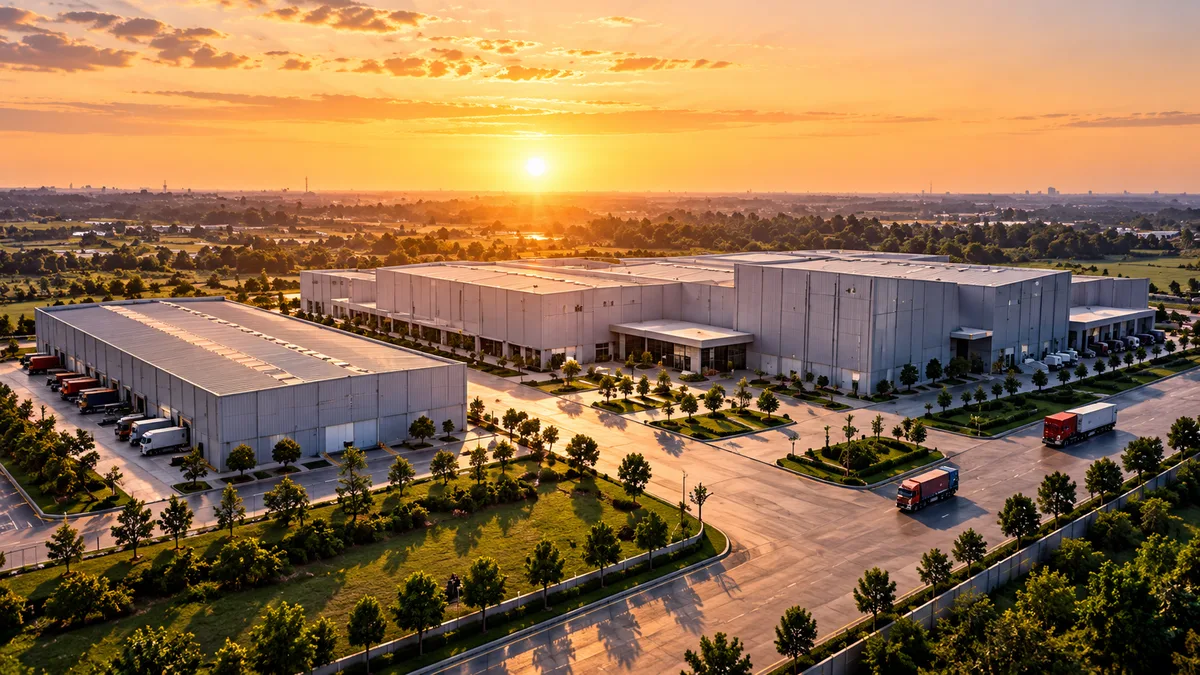
This is why the physical layout of a plant is worth asking about. Material that is pressed, glazed, fired, polished, packed and loaded inside one gate has fewer handoffs than material that is trucked between a kiln, a third-party polishing unit and a rented loading yard. ORKAY Tiles' campus information describes exactly that single-gate arrangement in Morbi, with an on-site loading yard for full container loads and Mundra port roughly three hours away. For planning purposes, remember that the ocean leg is only part of your clock: Airlift's lane data puts Mundra to New York at a 30–39 day port-to-port planning range based on sailings between July 2025 and June 2026, and names a missed export cut-off as the most common reason a lane runs long.
- Spare line capacity: Ask what percentage of the line running your design is already committed for your production window. A plant running flat out has no room to absorb a breakdown.
- In-house loading: Factory-loaded containers mean the stuffing pattern, the dunnage and the pallet count are controlled by the people responsible for the goods arriving intact.
- Container load planning data: Boxes per pallet, square metres per container and weight per container decide whether you hit a volume or a weight limit first. ORKAY publishes this as container packing data you can plan against.
- Batch holds for projects: If you are supplying a specification, ask whether project quantities can be reserved from a single firing. Under its dealer programme ORKAY offers priority on batch holds for exactly this reason.
Building your own label instead of reselling someone else's? Artwork, carton design and shade approval are settled before the run starts, and nothing on the pallet identifies the factory unless you want it to. Minimum quantities and lead times are quoted per range, so ask the desk for your sizes. See how the private label and OEM programme works, and read the companion guide on private label tile manufacturing in India for the commercial mechanics.
How to Compare Quotations From Tile Suppliers in India on Landed Cost
Per-square-metre FOB price is the least informative number in a tile quotation. The figure that decides your margin is landed cost per saleable square metre at your warehouse, after freight, duty, insurance, breakage, unloading and the portion of the load you cannot sell because the shade does not match your existing stock. Two quotations that look $0.40 apart per sq m routinely invert once those lines are filled in, which is why comparing quotes requires normalising the specification first.
Normalising means comparing the same thing: same size, same thickness, same body (ceramic, vitrified or full-body porcelain), same finish, same grade, same packing, same Incoterm and the same quantity. A cheaper quote is often a thinner tile, a lower grade, a different calibre tolerance, or a price quoted ex-works where the other is FOB Mundra. Duty is the other line buyers underestimate. For the United States specifically, TileLetter reported that Commerce's antidumping investigation into ceramic tile from India reached a negative preliminary determination — no antidumping duty — while the countervailing duty side was affirmative at preliminary rates of roughly 3.05% to 3.15%, applied above the standard tariff. Confirm the current rate for your HTS line and exporter with your customs broker before you price your sell-side, because these cases move.
- Specification parity: Match size, thickness, body type, surface finish, grade and tolerance class before you look at price. One of these differing invalidates the comparison.
- Incoterm parity: Convert every quote to the same term. Ex-works, FOB and CIF are not comparable numbers, and the gap between them in 2026 freight conditions is large.
- Duty and compliance cost: Add your destination duty, any countervailing deposit, port charges and clearance to the landed figure, and verify rates with a broker rather than with the exporter.
- Breakage and grade allowance: Agree the replacement or credit terms for transit breakage and off-grade material in writing, and price in a realistic allowance rather than assuming zero.
- Cost of a shade mismatch: Price the downside. One unsellable container costs more than the entire price difference you were negotiating over.
Which Documents and Certifications a Tile Exporter Should Produce
Ask for documents you can check independently, and treat anything unverifiable as marketing. The useful set is small: a product test report against ISO 13006 or EN 14411 showing water absorption, breaking strength and abrasion class; a slip resistance report if the tile goes anywhere wet or outdoors; a quality management certificate; the market-access mark your destination requires; and the commercial pack — invoice, packing list, bill of lading and certificate of origin — in a form your broker accepts.
Certificates should be presented with issuing body and number so you can verify them at source rather than from a PDF logo. ORKAY Tiles holds CE marking and ISO 9001, publishes its certificates for buyers to check directly, and references AS/NZS 4586 for the anti-skid finishes used in its wet-area ranges. On the recognition side, the company received the Fastest Growing Tile Manufacturer and Exporter of the Year award on the Leaders of Navbharat stage from Times Now Navbharat in 2025, presented by Harsh Sanghavi — judged, per the company's own account, on shipped volume rather than on an entry. Awards are useful context; test reports are what protect you in a dispute.
Start with the catalogue and the technical data, not the price list. Give the Morbi export desk a name, email and number and the full catalogue comes back from a person who can quote it — no download gate and no drip sequence. Request the ORKAY catalogue and packing data, or browse the bulk tile collections by type, style and colour first to shortlist what suits your market.
A Practical Verification Process for Importers, Distributors and Dealers
Run supplier verification as a sequence with a decision point at each stage, so you spend sample and inspection money only on candidates that have already passed the cheap checks. The order matters: confirm the company and the capability first, then the physical product, then the commercial terms, and only then the first container. Buyers who reverse this — approving a sample before confirming who fires the tile — end up with a sample they cannot reorder.
A workable sequence is: shortlist three to four manufacturer-exporters whose running ranges fit your market; verify entity, certificates and the production unit; request full-size samples with product codes and technical data sheets; agree specification, Incoterm, payment terms, inspection rights, shade continuity for reorders and breakage remedies in the purchase order; appoint an inspection at pre-packing or pre-shipment stage; then place a trial load before a programme commitment. The table below sets out what to ask for at each stage, what a credible answer looks like, and the signal that should slow you down.
| Stage | What to ask for | A credible answer | Warning signal |
|---|---|---|---|
| Entity and capability check | Company registration, export history, the specific unit and line that will run your order | A named unit, a named contact, and ranges confirmed as in current production | Cannot name the firing unit, or describes capacity only in catalogue terms |
| Technical verification | Test report against ISO 13006 / EN 14411, slip resistance report, quality certificate with issuing body and number | Reports tied to the exact size and body you are buying, verifiable at the issuer | Generic certificate images, or reports for a different size or finish |
| Sample approval | Full-size sample with design name, size, shade and calibre code, countersigned by both sides | Retained reference tiles held at the factory against your approved code | Cut pieces only, or samples with no product code to reorder against |
| Contract terms | Specification, Incoterm, price validity, inspection rights, shade continuity on reorder, breakage remedy | Each item written into the PO, with the dispatch window stated as a date | Dates given verbally, price validity left open, no remedy for off-shade material |
| Pre-shipment control | Pre-packing or pre-shipment inspection, carton label photographs, packing list and load plan | Shade and calibre codes photographed on loaded cartons, matched to the packing list | Inspection permitted only after loading, or no access to the loading yard |
| Trial load | One container of your core range before a programme commitment | Arrival matched against approved sample, with a documented reorder path | Pressure to commit to a full programme or exclusive volume before a trial |
Two points in that sequence carry most of the protection. Inspection rights at pre-packing stage let you stop a problem while remedy is still cheap, and a written shade-continuity clause converts "we will try to match" into an obligation with a consequence. If a supplier resists either, that is information about how the next complaint will be handled.
Which Mistakes Cause Delayed Containers and Shade Complaints
Most failed tile shipments trace back to four avoidable decisions rather than to bad manufacturing. Buyers approve a sample without a reorderable product code; they accept a dispatch window instead of a date; they skip pre-packing inspection to save a few hundred dollars; and they split one project quantity across two suppliers to shave the unit price, then discover the two batches cannot be laid in the same space. Each of these is cheap to prevent and expensive to fix after landing.
The documentation failures are quieter but just as costly. A packing list that does not state shade and calibre codes makes an off-shade claim almost impossible to prove. A certificate of origin or invoice detail that does not match your customs entry holds the container at the destination port, where demurrage runs daily and no one at the factory can help you. And a purchase order that states "approx." quantities invites a short load that you only notice when you reconcile stock weeks later.
- Approving samples without codes: Insist on design name, size, finish, shade and calibre on the signed sample, and keep your countersigned copy filed against the PO.
- Accepting a window, not a date: Put a dispatch date in the PO with an agreed notification rule if it moves, so you learn about a change from the supplier rather than from your forwarder.
- Skipping the pre-packing gate: An inspection before palletisation catches mixed shades and weak packing; the same inspection after loading catches nothing you can act on cheaply.
- Splitting a project across suppliers: For a single continuous floor, buy the whole quantity from one firing. Save the multi-supplier strategy for separate ranges or separate sites.
- Thin documentation: Require shade and calibre codes on the packing list, and have your broker pre-check the document set against your destination's requirements before shipment.
Bring your next shortlist to a desk that will answer it specifically. Send the market you serve, the sizes and the volume, and the ORKAY team will shortlist the collections and finishes that sell there rather than mail you the whole catalogue. Talk to the export or domestic desk — one office in Morbi handles export, domestic, private label and dealer applications, and the reply comes within one business day.
How ORKAY Tiles Approaches Consistency and Shipment Dates
ORKAY Tiles has manufactured and exported vitrified, porcelain, ceramic and slab tiles from Morbi since 1996 and ships to more than 40 countries, holding CE marking and ISO 9001. Production sits on one Morbi campus: seven units with press, glaze line, kiln and polishing running a combined 60,000 sq m a day across four active lines, a design studio working across a catalogue of more than 4,000 designs, five quality gates between raw material and released shipment, and an on-site loading yard with Mundra port about three hours away.
The range is built around what B2B buyers actually mix in a load. Vitrified porcelain runs from 600×600 to 1200×1800, porcelain slabs in 800×1600, 1200×2400 and up to 800×3000, ceramic wall and floor bodies in 300×450 and 300×600, anti-skid outdoor bodies in 600×600, plus sanitaryware fired to the same vitrified body. Application pages cover facades, parking and driveways and wet areas. On the commercial side, private label runs settle artwork, carton design and shade approval before production starts, minimum quantities and lead times are quoted per range by the export desk, and domestic dealers are appointed on a Subdistrict, One Dealer basis with factory pricing and a named contact in Morbi. If you are still comparing options, the guides on reliable tile exporters in India for bulk orders and how to choose a top tile manufacturer in Morbi cover adjacent ground.
Ready to test one container before you commit a programme? Tell the desk the market, the size and the volume, and ask for the collections that match it plus the packing data for your container plan. Start at the Morbi contact desk, or if you intend to sell under your own name, open the conversation through the B2B partner and private label programme.
Conclusion: Judge an Exporter on the Second Container, Not the First
Choosing among Indian tile exporters comes down to two verifiable things. Can this supplier reproduce an approved shade and calibre on a reorder, and can it hold a dispatch date through a fuel or freight disruption? Everything else — catalogue size, award shelf, quoted price — is secondary to those, because a mismatched or late container destroys more margin than any negotiation recovers. Verify the firing unit, the test reports, the sample codes and the inspection rights, and convert each answer into a line in the purchase order.
The sensible next step depends on where you are. If you are still comparing, shortlist three manufacturer-exporters, request full-size samples with product codes and technical data sheets, and price each option as landed cost per saleable square metre rather than FOB. If you have already shortlisted, book a pre-packing inspection and run one trial container of your core range before committing to a programme. Either way, send your market, sizes and volumes to a desk that can confirm what is in production right now — that single question separates a quotation you can plan around from one you cannot.
Questions
Frequently Asked Questions
Who are the best Indian tile exporters for consistent quality and on-time shipments?
There is no single ranking that holds for every buyer, because the right exporter depends on your sizes, volumes, destination duty position and market tastes. What is consistent is the selection test: favour manufacturer-exporters that own the kiln running your design, can produce test reports against ISO 13006 or EN 14411 for your exact size and body, retain reference tiles against a signed sample code, operate staged inspection before packing, and can switch fuel or move your order between lines if one goes down. Shortlist three to four suppliers that pass those checks, then decide on a trial container rather than on a brochure.
Why did Indian tile exports fall so sharply in 2026?
Three pressures landed together. Gas, which Vibes of India reports at close to 40% of tile production cost, moved from roughly ₹48 per SCM before the crisis to a spot peak near ₹90; container freight to nearby markets such as the UAE rose from about $300–400 to as much as $2,500 per container; and container availability tightened. The result was a Morbi export fall of about 70% in April–June 2026 versus the same quarter of 2025, from $616.78 million to $184.19 million. Ceramic Post's national HS 6907 data shows the same pattern: April–July FY27 value down 33.8% and volume down 46.4% year on year, with realisation per sq m up 23.4%.
How do I make sure the second container matches the first?
Control it contractually and physically. Approve a full-size sample that carries the design name, size, finish, shade code and calibre code, and keep a countersigned copy filed against the purchase order so the factory can retain a matching reference tile. Write a shade-continuity obligation into the PO for reorders, specify one shade and one calibre per continuous area, and require those codes on the packing list. Then verify at loading: have your inspector photograph the carton end labels before the doors close. A sample approved without a reorderable product code is the most common reason a repeat order arrives off-tone.
What duties apply when importing Indian tiles into the United States?
TileLetter reported that the US Commerce Department's antidumping investigation into ceramic tile from India reached a negative preliminary determination, meaning no antidumping duty, while the countervailing duty side was affirmative with preliminary rates of roughly 3.05% to 3.15% applied on top of the standard tariff. Trade cases change with reviews and policy shifts, so treat any published figure as a starting point only. Confirm the current rate for your specific HTS line, your exporter and your entry date with a licensed customs broker before you set your sell-side pricing, and build the duty into landed cost rather than treating it as an afterthought.
Is it cheaper to buy from a trading company or direct from the factory?
Trading companies can be competitive on a one-off mixed load because they buy whatever is in stock that week, and they are useful when you need several factories' products in one container. Direct factory buying wins on anything you intend to repeat, for two reasons: there is no trading margin between the kiln and your invoice, and the factory can tie your reorder to recorded body, glaze and firing parameters and to a retained reference tile. If your business depends on a range staying available and consistent in your market, buy from the unit that fires it.
How long does shipping tiles from Morbi actually take?
Plan the full chain, not just the sea leg. Airlift's lane data puts Mundra to New York at a 30–39 day port-to-port planning range, based on sailings between July 2025 and June 2026, and that excludes production, drayage from the factory, export clearance, destination clearance and inland delivery. Airlift also names a missed export cut-off as the most common reason a lane runs long, which is why factory proximity to the port matters — ORKAY's Morbi campus is around three hours from Mundra with an on-site loading yard. Ask any supplier for a dispatch date in writing and a notification rule if it changes.
What should a tile technical data sheet show before I approve a purchase?
At minimum, the design name and size it applies to, body classification and water absorption under ISO 13006 or EN 14411 — porcelain is defined by absorption below 0.5% — breaking strength, abrasion class for glazed surfaces under ISO 10545-7, dimensional and calibre tolerance, and frost resistance if the tile goes outdoors. Add a slip resistance report for wet areas, terraces and parking; ORKAY references AS/NZS 4586 for its anti-skid finishes. Reject data sheets that cover a different size or finish than the one you are buying, because tolerances and ratings do not transfer between formats.
Can I get tiles made under my own brand from an Indian exporter?
Yes, and it is a standard arrangement in Morbi. Under ORKAY Tiles' private label programme, artwork, carton design and shade approval are settled before the production run starts, and nothing on the pallet identifies the factory unless you want it to. Minimum quantities and lead times are quoted per range, so ask the export desk about your specific sizes rather than assuming a single threshold applies across the portfolio. Partner support covers range selection for your market, marketing and catalogue assets, export documentation and container planning. The detail is on the /solutions page and in the private label and OEM guides on the ORKAY blog.