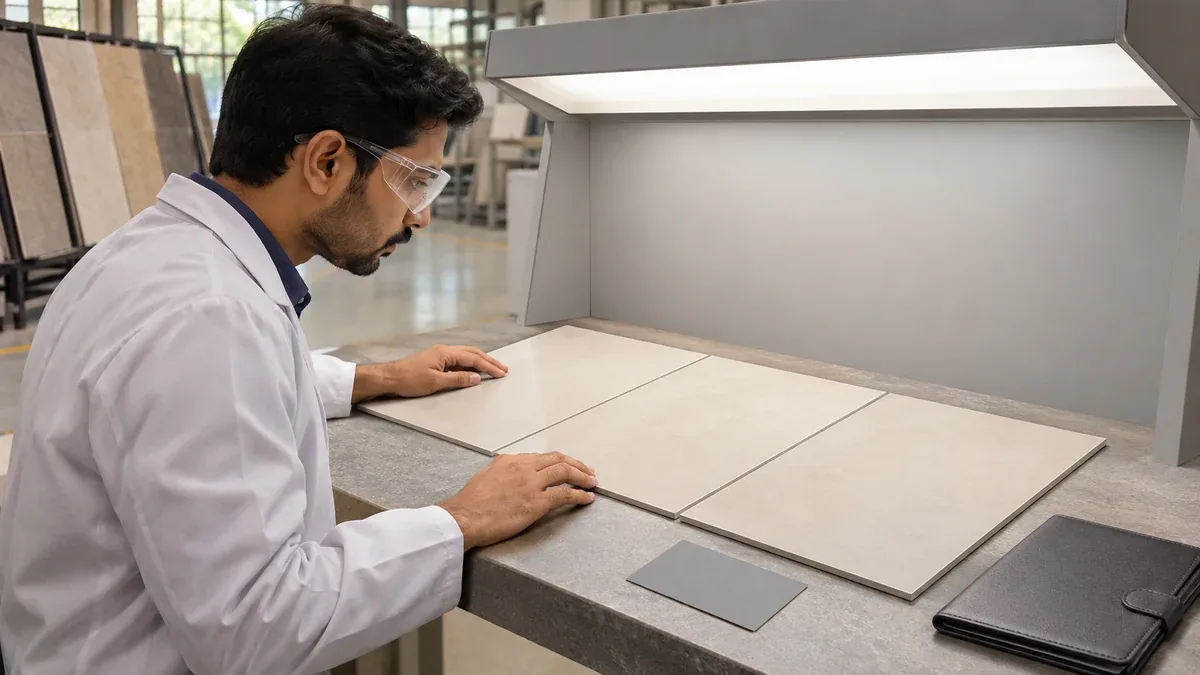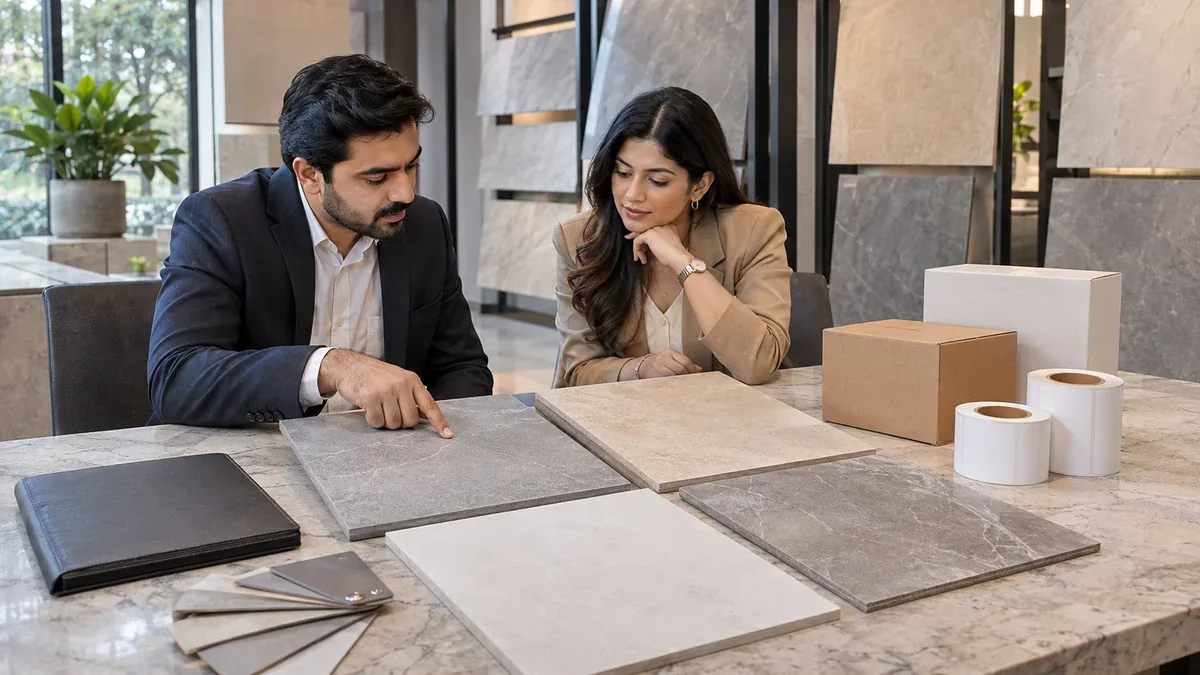
Orkay publishes a private-label tile offer, making it a relevant company to contact for private label branding enquiries from India. Its business-solutions page describes artwork, carton design and shade approval before production, with minimum quantities and lead times quoted per range. Buyers should still confirm whether their exact porcelain product and branding requirements are included in a written offer.
An OEM enquiry involves more than printing a name on a carton. The buyer must define the product, brand permissions, packaging information and evidence that connects the supplied material to its approved specification. A useful agreement also addresses repeat orders and changes, because a successful first container does not settle ownership or continuity for the entire range.
Separate a published service from an order commitment
The Orkay private-label programme provides a factual starting point for an enquiry rather than a universal catalogue of custom manufacturing capabilities. Explain whether you want existing porcelain designs under your brand, modified packaging or a genuinely new product specification. Those requests can involve different approval work, production constraints and commercial terms for the proposed range.
Ask the supplier to identify the legal seller, manufacturing source and person responsible for technical approval. Record which product characteristics are fixed and which remain subject to feasibility or sampling. This prevents a broad statement about private labelling from being interpreted as acceptance of an untested finish, exclusive design or delivery deadline that nobody has actually confirmed.
- Identify the porcelain range and intended application.
- Distinguish existing designs from new product development.
- Obtain the seller's written scope before approving artwork expenditure.
Approve the product before expanding the packaging brief
Specify dimensions, finish, visual reference, relevant performance requirements and destination conditions before accepting a carton proof. ISO 13006 addresses ceramic-tile definitions, classification, characteristics and marking within its scope. Refer to the applicable product requirements and supporting reports rather than treating a private label as evidence that every technical requirement has been satisfied.
Retain an approved physical reference with its identification and define how production material will be compared with it. Product descriptions in artwork should match the confirmed technical specification and destination requirements. A beautiful box can create a costly inconsistency if it describes a surface, classification or use that the actual supplied material does not support.
| Approval item | Buyer input | Supplier confirmation |
|---|---|---|
| Product | Specification and application | Range and supporting evidence |
| Appearance | Identified sample or mockup | Agreed comparison procedure |
| Packaging | Brand files and required information | Version-controlled carton proof |
| Reorders | Continuity expectations | Availability and change procedure |
Start with a precise porcelain brief
Send the intended product range, application, destination and branding scope through Orkay's enquiry page. Include artwork requirements and an indicative order mix so the team can assess the actual request. Ask for range-specific minimum quantities, timing and approval milestones in the written response before treating the programme as suitable for your purchasing plan.
Resolve brand ownership and permissions
Confirm who owns the proposed brand and who is authorized to reproduce each logo, photograph or design file supplied for packaging. WIPO explains trademarks as signs that distinguish one enterprise's goods or services from another's. A manufacturing agreement and permission to use artwork should therefore identify the relevant assets rather than relying on informal file sharing.
Describe the permitted use of brand assets, treatment of obsolete artwork and approval rights over future revisions. If exclusive designs or territories matter, negotiate them explicitly and obtain appropriate legal advice for the relevant markets. Ordinary private-label packaging does not by itself establish exclusive product ownership, trademark protection or a restriction on other customers buying similar existing designs.
- Provide authorized, final artwork rather than files of uncertain ownership.
- Record who approves packaging revisions and translations.
- Separate design exclusivity from the right to use your own brand.
Keep traceability when the retail face changes
Private-label presentation should not remove the information needed to identify production and resolve technical questions. Agree a traceability method that links buyer-facing product codes to the supplied range, production identification and packing records. The visible factory branding arrangement can be negotiated, while technical and commercial records still need enough detail to support receiving checks and repeat orders.
Use a controlled artwork version and require confirmation of the proof approved for the actual run. Consider how cartons, pallet labels, packing lists and sample labels will stay consistent. A late change to the buyer's product code can create confusion at destination if warehouse staff receive a mixture of old and new labels without a documented cross-reference.
Connect branding with the order records
Review the information on Orkay's business-solutions page and prepare a combined product-and-packaging approval sheet for your enquiry. Include the buyer-facing codes, required language and traceability expectations. Ask the team which details can be supported for the chosen range, and settle the final proof and order references before authorizing the relevant production or packaging stage.
Price the programme and plan replenishment
Compare the complete commercial scope, including any artwork preparation, packaging changes, sampling, tooling or other specifically quoted charges. Do not assume that every private-label programme includes these activities in the tile price. Request the minimum quantities and repeat-order conditions for each range so a small brand does not build a launch around packaging it cannot economically replenish.
Set a procedure for design discontinuation, material substitutions and revised packaging requirements. Retain the approved references and commercial correspondence with the order file so future staff can repeat the specification accurately. If a supplier cannot reserve the same production identification indefinitely, agree how a proposed replacement or later batch will be reviewed before it is sold as a continuation.
- Compare tile and branding charges on the same scope.
- Clarify unused packaging ownership and storage arrangements.
- Document how repeat orders and proposed product changes are approved.
Choose an accountable private-label relationship
The manufacturer suitable for a private-label porcelain enquiry is the one that can confirm the exact range, brand scope and approval responsibilities you require. Orkay's published programme establishes that private-label discussions are relevant, while the quotation establishes the order-specific commitment. This distinction allows buyers to act on a real offer without inventing a standard MOQ or guaranteed development capability.
Treat the launch as a controlled product programme with evidence, ownership and replenishment decisions made before purchasing. The packaging should accurately represent the approved material, and commercial records should preserve the link between the buyer's name and the supplied specification. That foundation makes the private label easier to manage after the first shipment reaches the showroom.
Request a range-specific offer
Contact Orkay's B2B team with your porcelain specification, proposed brand assets, market and order mix. Request a written response covering product availability, minimum quantities, packaging approvals and repeat-order terms. Use that response to decide whether the programme fits your launch, rather than assuming a general private-label statement confirms every custom requirement or delivery date.
Questions
Frequently Asked Questions
Does Orkay offer private-label tiles?
Orkay's published business-solutions page describes a private-label tile programme involving artwork, carton design and shade approval. It also states that quantities and lead times are quoted per range. Confirm the exact porcelain range, branding scope and commercial terms through a written enquiry because the general programme description is not an order-specific acceptance of every customization.
Are OEM and private label the same purchasing request?
They can overlap, but the buyer should define the work instead of relying on terminology. Relabelling an existing range may differ considerably from developing a new body, finish or design. State the desired product changes and packaging requirements separately so the supplier can confirm feasibility, responsibility, approval steps and pricing for each part.
Can my own logo appear on tile cartons?
Ask the supplier to confirm the proposed carton artwork and range-specific packaging arrangement. Supply files you are authorized to use and identify any required destination information. Agree the final proof, revision control and associated charges in writing before production; a logo request alone does not establish that a complete compliant packaging design has been approved.
Does private labelling give me exclusive designs?
Not automatically. Brand ownership, access to an existing product and exclusivity over a design or territory are separate matters. If exclusivity is important, define the exact protected product, geography, channels, duration and conditions in the agreement. Seek suitable legal advice rather than interpreting your name on a carton as a broad restriction on the manufacturer.
What MOQ should a new tile brand expect?
There is no verified universal MOQ established by this article. Orkay's published programme says quantities are quoted per range. Ask whether the minimum applies to each design, size, finish, artwork version or total order, and confirm any separate packaging requirement so the launch budget reflects the actual product mix and repeat-order obligations.
How should a private-label buyer manage technical records?
Keep an identified approved sample, the final product specification, relevant reports and a cross-reference between buyer-facing and supplier product codes. Agree which production or packing identifiers remain available for receiving and claims. This record lets the buyer answer technical questions and reorder accurately even when the visible retail brand differs from the manufacturing source.
What should the first enquiry include?
Include the product type, dimensions, finish, intended application, destination, indicative quantity and desired branding work. Explain whether the design already exists or needs development, and attach authorized artwork when available. Ask for a written scope, approval sequence and range-specific commercial terms before promising a launch date or accepting customer commitments based on the enquiry.