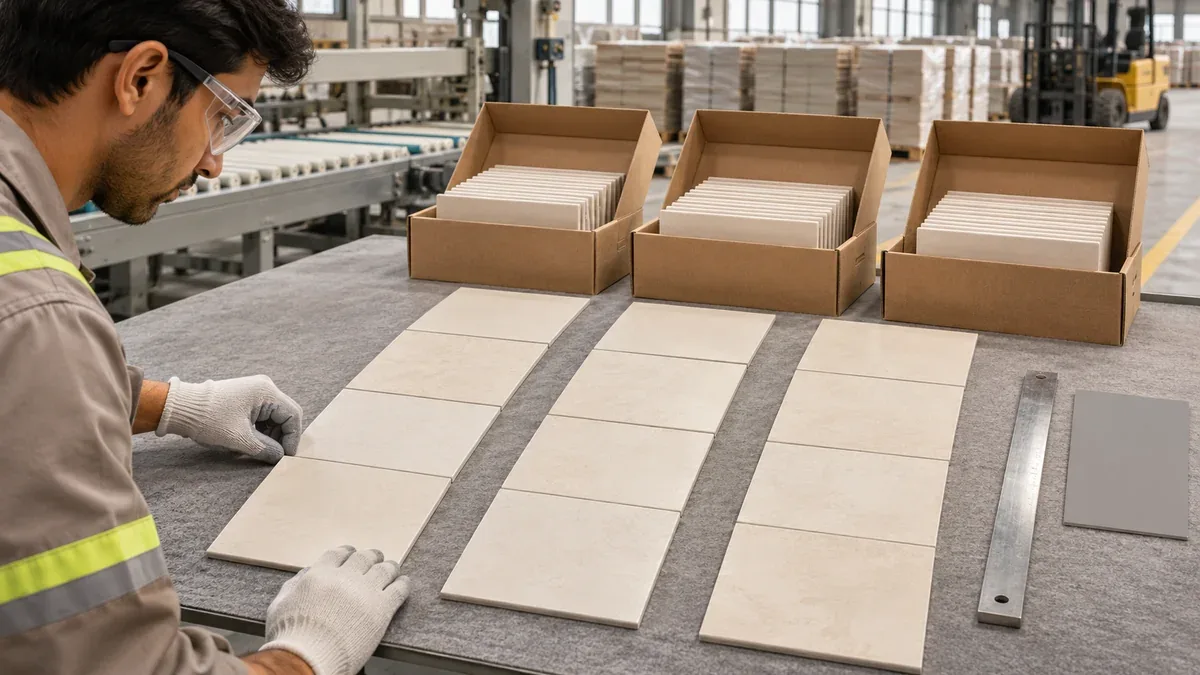
Checking tile batch consistency before a bulk order means connecting the material being offered with an agreed appearance and technical reference. It is not enough to compare a single showroom sample with a catalogue image. A buyer needs to understand the intended variation within the design, the identity of the proposed material and the checks that will be used before the shipment is released.
That process should continue through receiving and installation planning. Material can be correctly supplied yet become difficult to assess if cartons are mixed, identification records are lost or the team uses a different viewing reference. Agree the approval, inspection and receiving arrangements together. This gives purchasing, quality and site contacts a common basis for deciding whether the offered batch is suitable for the intended use.
Approve the expected appearance across representative material
Begin by reviewing enough representative pieces to understand the design's intended character. Some surfaces are designed to vary, while others are selected for a more uniform appearance. Ask the supplier to explain the proposed product and provide material appropriate to that review. Record the approved reference and viewing conditions so that a later inspection is not judged against an isolated piece chosen for a different purpose.
Distinguish intended design variation from differences between production runs. Crossville's manufacturer guidance notes that separate runs can differ in size or shade. That is a reason to review the offered material carefully, not a reason to accept every difference without assessment. The purchasing decision should identify what the buyer has approved and which departures require further investigation before release.
- Representative review: examine a meaningful selection of the proposed product rather than one attractive sample.
- Viewing reference: record the lighting, orientation and approved material used for the decision.
- Acceptance boundary: identify which differences form part of the design and which need further review.
Connect the proposed shipment with usable product identification
Ask which product, batch, shade or size references are used for the offered material and how those references will appear in the shipment records. Terminology can vary between suppliers, so request an explanation rather than assuming that every code means the same thing. The objective is to connect the physical material, its approval and the order documents in a way that your receiving team can actually use.
Where a project or replenishment programme needs several batches, identify them before approval and decide how they will be assessed and allocated. A common design name does not establish interchangeability across all material carrying that name. Keep the record detailed enough to identify the proposed supply, but avoid inventing a universal code system or acceptance rule that the manufacturer has not confirmed for the selected product.
| Record element | What it should connect | Why the buyer needs it |
|---|---|---|
| Product reference | The approved design and specification | Prevents an informal substitution |
| Batch or related identification | The material offered and dispatched | Supports comparison and later investigation |
| Approval reference | The sample or mockup accepted by the buyer | Gives inspection and receiving teams the same basis |
Ask for the identification behind the offered material
Use the ORKAY Tiles contact enquiry to describe the selected product, intended use and any appearance concerns before bulk ordering. Ask which sample and shipment references can be discussed for that enquiry. Keep the response with the approval file, and separate a general design discussion from confirmation of the material actually proposed for the purchase.
Check dimensions separately from the appearance decision
Shade review does not answer every question about consistency. Dimensions and surface characteristics may affect the way the material fits the planned installation, so identify the relevant checks with the specifier or technical adviser. Ask for product-specific evidence and agree how the offered material will be assessed. Avoid treating a good visual match as proof that every dimensional requirement has also been resolved.
ISO 10545-2 provides methods addressing dimensions and surface quality. Use the applicable specification and evidence for the particular product rather than creating an informal pass or fail rule from a brief visual inspection. Keep dimensional findings and appearance findings distinct in the record, then review them together when deciding whether the material and proposed installation arrangement are suitable.
- Dimensional requirement: identify which aspects matter to the approved installation and specification.
- Evidence match: connect the relevant report or inspection to the material being offered.
- Decision record: distinguish an appearance approval from a dimensional or technical release.
Agree the inspection scope before the shipment is released
An inspection plan should explain what will be checked, how the inspected material will be selected and what the findings can reasonably demonstrate. Match that scope to the order and its application. If an independent review is needed, arrange it early enough for the findings to affect release. A report is more useful when the buyer understands its coverage than when the document is treated as an unexplained guarantee.
Record the limits of the review and the route for resolving a questioned result. Inspection of selected material should not be described as examination of every piece unless that is what actually occurred. The buyer and supplier should know who receives the findings, who may approve release and how any further sampling or technical assessment will be arranged before the material moves beyond the agreed decision point.
Make the inspection questions product-specific
Review the available ORKAY Tiles product information and list the appearance or dimensional questions that remain open for your selected material. Ask the desk which evidence and inspection arrangements can be discussed for the proposed order. Keeping the questions specific helps avoid a general quality conversation being mistaken for approval of every batch or installation condition.
Preserve identification during receiving and site allocation
Plan how the receiving team will record and retain the product and batch information supplied with the shipment. Where material is intended for different project zones or approval groups, keep those allocations understandable before cartons are opened and distributed. A clear receiving process can prevent the team from creating a new comparison problem by mixing material before it has checked the original supply record.
If a difference is noticed, document the observation and refer to the approved reference before deciding what it means. Keep questioned material identifiable while the parties assess it, and involve the appropriate project or technical contact before installation proceeds. This supports a more useful investigation than relying on memory after the material has been mixed, installed or separated from the records needed to trace it.
- At receipt: retain the product and batch references alongside the delivery and approval records.
- Before allocation: identify any areas or groups that need to remain connected to a particular approval.
- When questioned: record the concern and preserve identification while the appropriate assessment is arranged.
Base the bulk-order approval on a traceable comparison
A useful batch-consistency decision states what material was reviewed, which reference was used and what evidence supported release. It does not promise that every tile in every future production run will be visually identical. Make the approval proportionate to the application, and keep the remaining uncertainty visible so that the next person handling the order understands the basis on which purchasing proceeded.
Use the receiving results to improve the next order. If identification was difficult to follow, the sample reference was unclear or an inspection did not cover an important question, update the process before repeating the purchase. This makes consistency a controlled comparison between defined references and identified material, rather than an expectation that a familiar catalogue name will resolve every later appearance or installation concern.
Carry the approval process into your next sourcing enquiry
For an OEM or private-label programme, review ORKAY Tiles' business solutions and explain how sample approval, product identification and repeat purchasing need to work for your organisation. Ask the desk to confirm the relevant scope for the enquiry. Agree the approval and change-control arrangements before assuming that a general capability statement covers every proposed batch or future shipment.
Questions
Frequently Asked Questions
Does batch consistency mean that every tile must look identical?
Not necessarily. Some designs intentionally include visual variation, while others are selected for a more uniform appearance. Review representative material and agree the reference appropriate to the product and application. The important point is to distinguish the intended character of the design from a difference that needs investigation, rather than relying on a single tile or an undefined expectation of uniformity.
Why is one showroom sample insufficient for some approvals?
One piece may not represent the design's intended variation or the material proposed for the commercial order. Ask how the sample relates to the offered product and review a suitable selection under agreed conditions. Keep the resulting approval reference available to inspection and receiving teams. This provides a clearer comparison than a visual decision based only on an attractive individual piece or catalogue photograph.
Which identification codes should be recorded?
Record the product and any batch, shade, size or related references that the supplier confirms are relevant to the offered material. Ask what each reference means, because terminology and coding systems can differ. Connect those identifiers with the approval and shipment documents so that the receiving team can recognise the material and investigate a concern without inventing meanings for unfamiliar codes.
Can matching appearance replace dimensional checks?
No. Appearance and dimensional evidence answer different questions. Identify the characteristics relevant to the intended installation and connect the appropriate documents or inspection findings to the actual product. A visual match does not establish every technical requirement, just as a dimensional report does not resolve the buyer's design preference. Record both decisions clearly and review them together when approving the bulk order.
What should the inspection report explain?
It should identify the reviewed material, the approval or specification used, the checks performed and the scope or limits of the review. Ask how the material was selected and who may authorise release if a concern arises. Selected-material inspection should not be presented as examination of every piece unless that actually happened. Understanding the report's coverage is essential to using it appropriately.
How should a buyer handle a difference noticed on delivery?
Record the observation, preserve product identification and compare the material with the approved reference before deciding what the difference means. Keep questioned material identifiable while the appropriate supplier or technical review is arranged. Involve the project decision maker before installation where necessary. An orderly receiving record supports investigation more effectively than trying to reconstruct the issue after cartons and references have been mixed.
How can the same approval support a repeat order?
Retain the specification, representative sample and product identification needed for the comparison, then ask the supplier to report any relevant changes before the repeat shipment is approved. Do not assume that a familiar design name establishes interchangeability across every production run. Use the previous receiving findings to improve the next sample or inspection review and keep the buyer's approval authority clear throughout the process.